Takeda CEO-Elect Julie Kim Urges Collaboration BILH Scientists
Julie Kim Emphasizes Collaboration, Representation in Talk with BIDMC Scientists
BOSTON — When Julie Kim takes the helm at Takeda in June, she will become the first woman and first Korean American to lead the nearly 245-year-old global pharmaceutical company. But speaking to a room full of scientists at Beth Israel Deaconess Medical Center on Feb. 12, the CEO-elect of Takeda made clear that the milestone is less about her than the work employees make possible.
"Even if I'm having a bad day at the office, it's nothing compared to what our patients go through," Kim said. "That's what keeps me grounded."
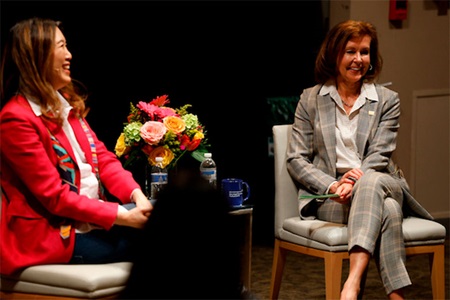
More than 200 scientists, clinicians, and trainees gathered in person or streamed the event online for Beth Israel Lahey Health's (BILH) fourth annual celebration of the International Day of Women in Science. The conversation, moderated by Gyongyi Szabo, MD, PhD, chief academic officer of BILH and Beth Israel Deaconess Medical Center (BIDMC), ranged across career strategy, industry-academia partnerships, health equity, and the representation of women in science leadership.
Szabo opened the program by acknowledging the physicians and scientists the event was designed to celebrate. "You are role models, not only for young women considering careers in science, but for all of us who believe in what academic medicine can and should be," she said. Szabo also urged women scientists to be supportive of one another and share the excitement of research discoveries to attract the next generation of women to the science field.
Peter M. Healy, divisional president of Metro Boston for BILH and president of BIDMC, called for intentional support of women scientists across the system in his welcoming remarks. “It’s our collective responsibility to create an environment where talent is recognized, voices are heard, and opportunities are truly accessible to everyone,” Healy said. “It requires supporting mentorship and sponsorship, ensuring fair pathways for advancement, and building a culture where excellence and inclusion go hand in hand.”
Strengthening Industry-Academia Partnerships
Much of Kim and Szabo's conversation focused on the relationship between academic medicine and industry. While academic scientists may embark on projects without a clear path to a commercial product, their work often lays the groundwork for the medicines that industry eventually develops.
Kim said Takeda’s discipline about staying in its lane — gastrointestinal and inflammation, neuroscience, and oncology — focuses their efforts internally and directs where they look for partnership. “You saw a whole host of companies jump on the GLP-1 bandwagon once a couple of companies had success,” she said. “We’re not. That’s not our area of expertise. We will continue to follow the science in our areas of therapeutic focus, which may come from our own in-house research or from external partners. If a company thinks they can discover everything within the four walls of their company, they're wrong," Kim said
Szabo raised BILH’s ambitions to complete building a clinical research network across the system by 2030, and the two discussed how academic health systems and industry can collaborate beyond the lab — on workforce pipelines, the implications of AI and automated labs, and reaching patients in underserved communities. Kim pointed to Takeda’s partnership with Partners In Health to train community health workers in areas where access to care is limited, noting that healthcare deserts are not confined to the rural Midwest or South. “We have them in Massachusetts as well,” she said.
The conversation took on added urgency given the uncertain federal funding landscape, with both Kim and Szabo acknowledging that traditional funding models may not be sufficient to sustain the pace of discovery. Kim called for new models of collaboration between academia and industry, “especially in this type of environment where science is not necessarily being invested in at a government level.”
A Career Built Like a Puzzle
Kim did not follow a conventional pharma track. The daughter and sister of physicians, she bypassed the typical and more traditional industry ladder of sales, marketing, and P&L management. She described her career not as a ladder but as a puzzle, with each role she took on over the years adding a piece she needed to add to achieve her long-term vision and goals.
Kim acknowledged that women remain vastly underrepresented at the top of major pharmaceutical companies.
"Early in my career, I didn't dream that I could one day be CEO of a Fortune 500 company. That wasn't on my radar," Kim said. "When I was coming up through the corporate world, there was never anyone who looked like me. Representation matters."
She also drew a distinction between mentors and advocates. Mentors can be anyone at any level, she said, but advocates are senior leaders present in rooms where career decisions are made. “I would not be here if I did not have advocates who could open doors for me,” Kim said. “Advocates will open doors. You have to walk through and deliver.”
Making Room at the Table
Asked how women scientists can better advocate for themselves and their work, Kim pointed to research showing that women routinely negotiate themselves down before they even enter the room — a pattern not exclusive to women, but one that often plagues the most qualified, she noted citing research. "Don't negotiate yourself down before you walk into the room," she said. "There are going to be plenty of people who will try to negotiate you down. You shouldn't be one of them."
Responding to a question from Juan Fernando Lopera, chief community and health impact officer at BILH, Kim described Takeda’s approach to health equity as embedded in its operations rather than treated as a side initiative. She also highlighted the company’s partnership with Partners In Health and its anchor sponsorship of the MassNextGen initiative, which supports women and underrepresented entrepreneurs in life sciences.
Kim’s broadest message was that breakthrough science depends on having different kinds of thinkers at the table.
“Diversity of thought — which often comes from having diverse experiences around the table — is when we get the breakthroughs,” Kim said. “I would encourage all of you to embrace your lived experiences. Everything you’ve gone through helps shape how you think, how you discuss, how you debate. Don’t be afraid of bringing that to the table.” Asked to name a woman in science she’d most like to have lunch with, Kim chose Nobel laureate Jennifer Doudna, renowned for her work with CRISPR genome editing. Szabo chose Marie Curie, citing the double Nobel prize-winning physicist and chemist’s groundbreaking work, her perseverance in an all-male laboratory, and her eventual death from exposure to the radioactive elements she discovered and handled in her lab.
“Keep doing what you’re doing, even if you have one of those frustrating days,” Kim told the audience. “Because one day, what you’re doing is going to have a significant impact, whether it’s on millions of people or just a few. It matters to those people.”
About Beth Israel Lahey Health
Beth Israel Lahey Health is a healthcare system that brings together academic medical centers and teaching hospitals, community and specialty hospitals, more than 4,700 physicians and 39,000 employees in a shared mission to expand access to great care and advance the science and practice of medicine through groundbreaking research and education.